Source: Maze Runner
Theory: Conflict TheoryTheorist: Karl Marx
Terms: social inequality, alienation, class, conflict, functionalism
Introduction
Karl Marx is placed in a captivated world, called a Glade. He arrives in an elevator and is woken up without any memory of anything and surrounded by many young men. He is treated differently from everyone else. He is told to do things he doesn't feel that is right for him. He battles to be treated rightful and not being alienated from the rest of their small society of captives. A girl, Teresa, is the first girl to get sent to the Glade and is apparently the last to ever get sent. Karl has to take risky chances to prove himself rightful to all the others to be a Runner and prove that he is the one that is capable of getting them all to safety and the real world. He is desperate to know what is beyond the walls and what is at the end of the maze. He will not stop until he has the answers to his questions and curiosity.
 Application
To understand the social inequality in The Maze Runner, a 19th century philosopher's perspective. Karl Marx is considered the founder of the conflict theory which explains social change through class conflict. This theory offers sociologist an explanation into social phenomenon such as The Maze Runner.
There are two big conflicts in this film, of which that are: Man vs. Man and Man vs. Society.
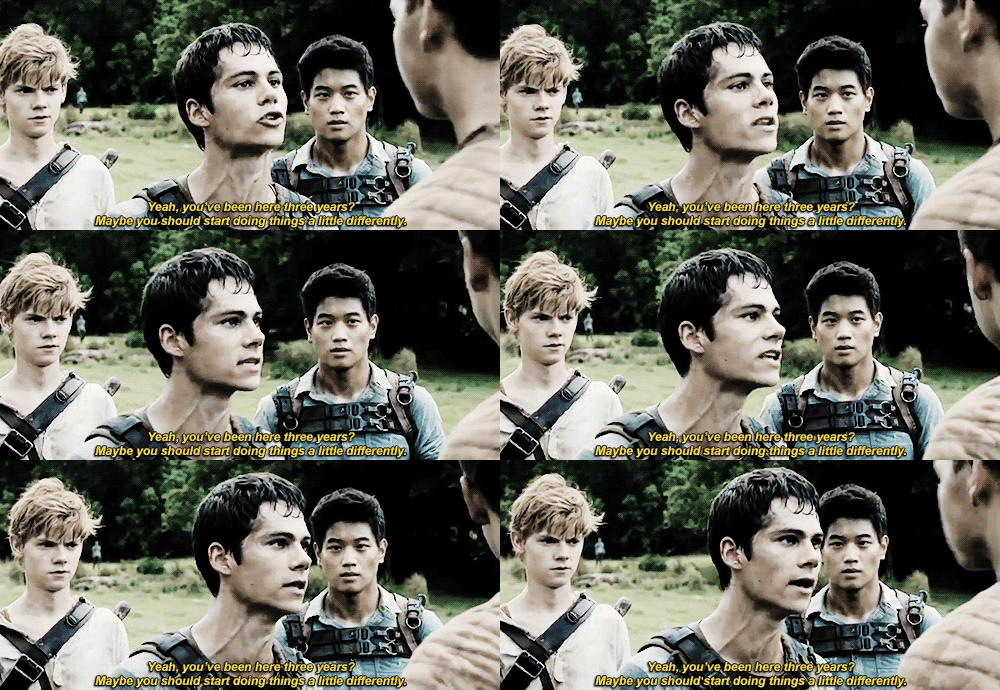
Man vs. Man would be Karl and Gally. They both grow to greatly dislike each other. Gally tends to bully and taunt Karl. Man vs. society would be the conflict between the Glade and the creators of the Maze. The creators stop providing the Glade with things such as sunlight and supplies. The people from the Glade got angry and everything started to change drastically after the creators stopped providing goods. It went downhill after that. It was a battle to stay alive and to find the end of the maze.
Everybody in the Maze are divided into classes based on there capabilities. Karl Marx uses the concept of class to show the social inequality the saw in the Glade. The younger kids that can hardly take part in the glade would be the lower class. Karl would be considered to be in the lower class due to the fact that he is treated lower and less superior to the runners who would be considered the top class. This also contributes to alienation. Karl shows the feeling of being isolated from the others. Karl gets placed in a cell-like cage thing. He gets isolated from the rest of the society. People that are infected or sick are forced out of the glade.
A revolution is started after the creators stop providing good and when the Glade starts changing. They must revolt in order to stay alive and find the creators. The only way to do that would be to get through the maze.... alive. Karl refuses to stay so he takes position as a leader and manages to get people to tag along with him and try to find a way out of the maze. Gally, on the other hand, gets a portion of people to go against Karl and stay in the glade. Which side would you choose? Would you stay in the glade and face anything that gets in or go out and battle anything to find a way out?

This consist mainly of conflict and functionalism. Functionalism is the theory that society serves a function and that is necessary for survival in society. It shows in the film how everyone had a part in society to keep it stable. There are many conflicts that go from man vs. man to man vs. nature and man vs. society. Functionalism also because you can see how the society works together to make a better life. There is conflicts between many of the characters due to their differences. http://themazerunnerbooks.weebly.com/conflicts.html
Conclusion
 This theory has helped me understand this source more by showing it in films such as The Maze Runner. It has helped me understand it more by allowing me to visually understanding it rather than mentally trying to comprehend it. This matters because it shows what societies do to maintain a stable status. Also, it shows how people tend to act different and treat people differently depending on their situation. It proves that society needs to function in order to be stable.